
For most people, the day they hire an immigration attorney is one of the hardest days of their life.
They have spent weeks, sometimes months, trying to figure out which category applies to them, whether they qualify, and whether the person offering to help them is even licensed to practice law.
Signing with a real attorney should feel like a relief, and it does, for about a day.
Then the waiting starts.
Immigration cases can sit in a queue for months or years, and during that stretch, the biggest source of client anxiety usually is not the law itself.
It is not knowing what is happening. Every unanswered email and every status update the client cannot fully understand chip away at the trust that made them hire the firm in the first place.
For firms serving Spanish-speaking clients, that gap widens fast.
A status update that reads clearly to an English-speaking case manager can come across as confusing or even alarming when a family member has to translate it informally at the kitchen table.
Client communication is not a side issue for immigration firms; it is the client experience, and that experience turns a single case into a decade of referrals.
Why Client Communication Is Part of Your Marketing Strategy
Most firms treat marketing and case management as two separate worlds.
Marketing is the website, the ads, and the SEO.
Case management is a separate department with an entirely different mindset.
That split does not hold up specifically in immigration law, because much of an immigration practice’s growth still comes from referrals and community reputation rather than paid channels, as a complete guide to immigration attorney marketing lays out in detail.
A client who felt informed and respected throughout their case becomes an unpaid marketing asset the day their green card, work permit, or asylum grant arrives.
They tell a cousin, a coworker, a pastor.
A client who felt confused or ignored does the opposite, quietly, and firms rarely find out why the phone stopped ringing from a particular neighborhood.
Research on client expectations across the legal industry directly supports this.
According to Clio’s Legal Trends Report research on client communication expectations, clients consistently rank timely, clear communication among the top factors in whether they would recommend a firm, and firms that improve their intake and communication experience see measurably more leads and revenue than firms that do not.
For an immigration practice, where referrals often flow through tight-knit community networks, that effect compounds fast.
This is exactly where bilingual marketing built for immigration firms and bilingual case communication start to overlap. An ad in Spanish that brings in a new client is only the first half of the job.
What happens after they sign is what determines whether that client becomes a five-star reviewer or a quiet complainer to their family.
Your Next Client Is Searching for You Right Now
Immigration clients are online every day, looking for a law firm they can trust. I help immigration attorneys show up in those searches, build credibility before the first call, and turn website visitors into booked consultations. See how I do it and what it costs for your firm.
Where Immigration Law Firms Lose Client Trust
A handful of communication gaps recur in immigration practices, regardless of firm size.
Delayed updates
USCIS timelines are already unpredictable, and clients know that. What erodes trust is not the wait itself; it is silence during the wait.
A client who has not heard from the firm in six weeks starts to wonder if their file was lost, even when nothing is actually wrong.
Confusing legal terminology
Terms like “Request for Evidence,” “priority date,” or “administrative processing” are second nature to a case manager and completely foreign to most clients.
Sent without explanation, these terms create fear rather than clarity.
Language barriers
A firm that markets in Spanish but only communicates case updates in English is sending a mixed message. The client was invited in one language and then managed in another.
Lack of transparency
Clients want to know what stage their case is at, roughly what happens next, and roughly when. Vague updates like “we’re still working on it” leave room for worry to fill in the blanks.
The Most Important Messages Clients Receive During Their Case
Every immigration case has a handful of moments that carry outsized emotional weight. Getting these specific messages right, in the client’s own language, matters more than almost anything else in the file:
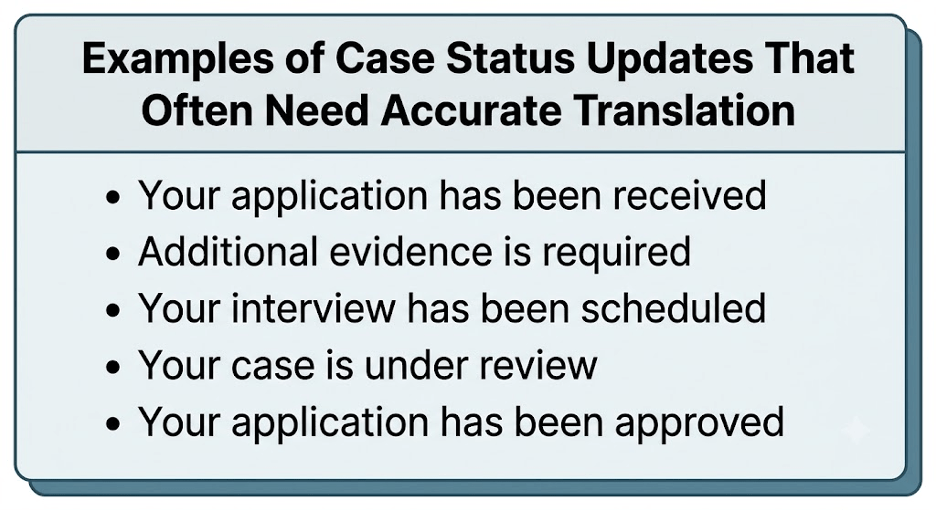
The very first one on that list, letting a client know their application has actually been received, is often the moment that sets the tone for the entire case.
It is the first proof that the process is real and moving.
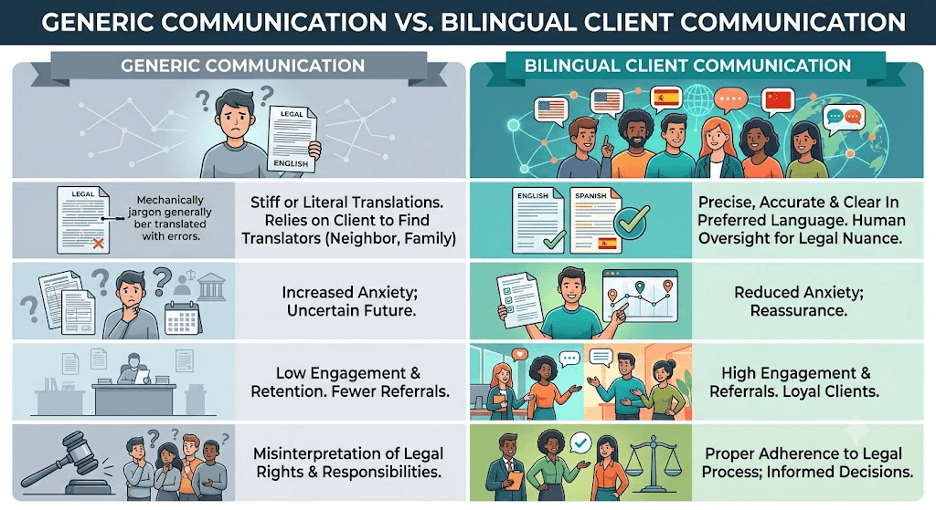
For Spanish-speaking clients, sending that specific line in clear, natural Spanish rather than a stiff or overly literal translation makes a measurable difference in how reassured they feel.
If your team wants a reference point, this Spanish translation example shows how that phrase is typically rendered when the goal is clarity over stiffness.
The same care should apply to every message on that list. A client who understands exactly what “additional evidence is required” means, and what they need to do next, is a far calmer client than one who receives a form letter they have to hand off to a neighbor to translate.
Building a Better Bilingual Client Experience
Being bilingual as a firm is not just about having a Spanish-speaking receptionist.
It means every touchpoint, intake forms, appointment reminders, case status updates, and the consultation itself, works equally well in either language.
A San Jose immigration firm’s four-year case study shows what this looks like on the marketing side: years of consistent results came from speaking directly to a Spanish-speaking community in a way that felt native, not translated after the fact.
The same principle applies inside the case file.
A client should never feel like the Spanish version of a communication was an afterthought, dashed off after the English version was already finalized.
When Spanish communication is planned from the start, it comes across as respectful.
When it is bolted on, clients notice, even if they cannot always articulate why something feels off.
Practically, this means training staff to default to the client’s preferred language rather than assuming English, building a small library of pre-approved Spanish phrasing for the most common case updates, and establishing a clear process for legal review of anything sent in a second language.
Technology Can Support Better Client Communication
The scale of the opportunity here is significant.
USAFacts’ analysis of Census Bureau data on Spanish speakers at home puts the number of U.S. residents who speak Spanish at home above 44 million, concentrated heavily in California, Texas, and Florida, and Pew Research Center’s data on U.S. Latino population growth shows the U.S. Latino population nearly doubling between 2000 and 2024.
For an immigration practice, that is not a niche audience; it is a large and growing share of the client base most firms will serve for the rest of their careers.
A handful of tools make consistent bilingual communication realistic for firms that do not have unlimited staff time:
- CRM systems that track which language a client prefers and flag it automatically on every future communication
- Client portals where case status, document requests, and next steps are visible in both languages at any hour
- Email automation for routine, predictable updates like confirmation of receipt or a scheduled consultation
- SMS updates for time-sensitive milestones, since many clients check text messages faster than email
- AI-assisted translation for drafting routine Spanish communications quickly, always followed by human review before anything sensitive goes out to a client
That last point matters enough to repeat: AI-assisted translation is a starting point for drafting, not a substitute for a bilingual staff member or attorney reviewing anything that touches a client’s legal rights. Speed helps with routine status updates. Judgment is still required for anything nuanced, sensitive, or legally consequential.
Best Practices for Immigration Law Firms
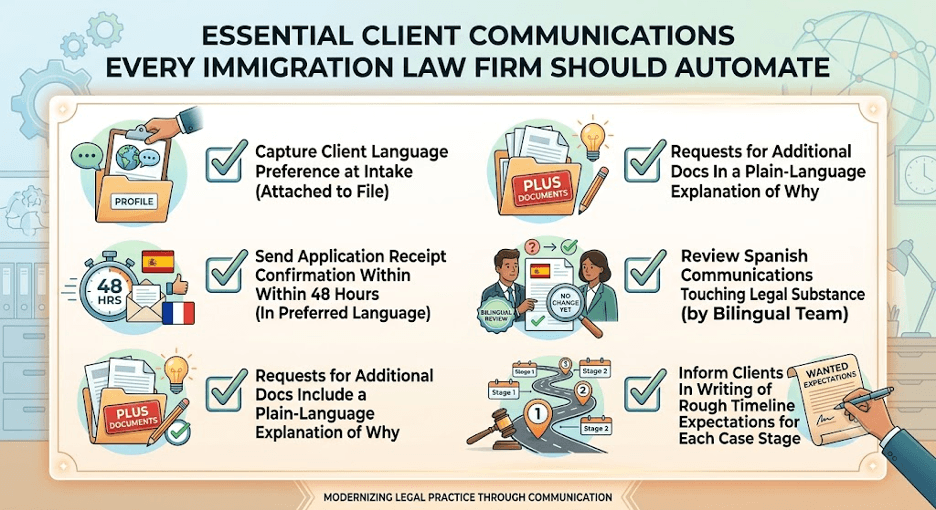
A short checklist worth reviewing against your own intake and case management process:
- Every client’s language preference is captured at intake and attached to their file, not just remembered informally
- Application receipt confirmations go out within 48 hours, in the client’s preferred language
- Requests for additional documents include a plain-language explanation of why the document is needed
- Case status updates go out on a predictable schedule, even when the update is simply “no change yet”
- Any Spanish-language communication touching legal substance is reviewed by a bilingual team member before it is sent
- Clients are told, in writing, roughly what to expect timeline-wise at each stage of their case
Final Thoughts
Marketing gets a Spanish-speaking client to pick up the phone.
Communication is what keeps them from calling a competitor six months into their case.
The firms that treat these as one continuous relationship, rather than two separate departments, are the ones building the kind of reputation that generates referrals for years. educational content that builds trust before the first call is one piece of that.
Consistent, clear, bilingual communication after the client signs is the other, and it is often the piece firms overlook.
If your firm’s Spanish-language communication feels like an afterthought right now, it does not need a full overhaul to start improving.
Pick one message, the application receipt confirmation is a good place to start, and make sure it goes out in clear, natural Spanish every single time.
Small, consistent wins like that are what client trust is actually built on.