This isn’t a “one is better than the other” answer, because that’s not how it works.
This article helps you figure out which one makes sense for where your business is right now.
I get this question constantly.
A business owner has decided they want to be more visible online, and they’ve narrowed it down to two options: pay for Google Ads to start showing up immediately, or invest in SEO to build something that lasts.
They want to know which one to pick.
The frustrating part is that most articles on this topic give you a thorough comparison of both channels and then end with something like “it depends on your goals,” which is technically true but completely useless if you’re trying to make a real decision with a real budget.
So let’s try a different approach. Instead of comparing them in the abstract, let’s talk about what each one actually does for a small business, what it costs in time and money, and most importantly, which situation calls for which.
What You’re Buying With Each One
The most important thing to understand about Google Ads and SEO is that they’re not two versions of the same thing; they’re two fundamentally different assets.
When you run Google Ads, you’re renting attention.
You pay Google to put your business in front of people who are actively searching for what you offer, right now.
The traffic is immediate, the targeting is precise, and the results are visible fast; the catch is that the moment you stop paying, the traffic stops completely.
There’s no residual effect, no equity built up, nothing that carries over to the next month.
When you invest in SEO, you’re building something you own.
A well-ranked page on Google doesn’t cost you anything per click, and it doesn’t disappear when you close your wallet.
The trade-off is that it takes time to build, often three to six months before you see meaningful results, and closer to twelve months before you feel the full compounding effect.
If you want to understand that timeline in more detail, I covered it in depth in this article about how long SEO takes to work.
Renting vs. owning.
That’s really the core of the comparison, and everything else flows from that distinction.
There is a bigger question sitting underneath this one, which is whether either channel is still worth entering when everyone else is already there. I took that on separately, in a piece about whether digital marketing is saturated.
Start Attracting Customers Through PPC Advertising Today!
We can help you create PPC campaigns that attract customers. Our services include bid management, keyword management, landing page performance reviews, and more.
A Side-by-Side Look at What Matters Most
| Google Ads | SEO | |
|---|---|---|
| Time to first results | Days to weeks | 3 to 6 months minimum |
| What happens when you stop | Traffic stops immediately | Rankings hold, often for years |
| Monthly cost structure | Management fee + ad spend budget | Service fee or time investment |
| Best for | Immediate leads, testing offers, seasonal push | Long-term visibility, brand building, compounding traffic |
| Control over results | High — you set budget, targeting, timing | Moderate — Google decides rankings |
| Scalability | Scales with budget | Scales with content and authority over time |
| Trust signal to visitors | Lower — labeled as “Sponsored” | Higher — organic results feel more credible |
| Works while you sleep? | Only while budget is running | Yes, 24/7 indefinitely |
When Google Ads Is the Right Move
There are situations where Google Ads is clearly the smarter choice, and trying to use SEO instead would be the wrong call.
You need clients in the next 30 to 60 days
SEO cannot help you here.
It’s not a criticism of the channel; it’s just a fact about how it works.
If your business genuinely needs leads in the short term, Google Ads is the only search-based option that can deliver them on that timeline.
You can have a campaign live and generating clicks within a week if everything is set up correctly.
You’re launching something new and want to test demand
Before you invest months into building SEO content around a particular service or offer, it makes a lot of sense to test whether people actually want it.
Google Ads lets you point traffic at a specific page and see in real time whether it converts.
If it does, you’ve validated the offer, and you know the SEO investment will be worthwhile.
If it doesn’t, you’ve saved yourself a lot of wasted effort.
You operate in a highly competitive market
In some industries, ranking organically for the keywords that drive business takes years of consistent effort and significant domain authority.
Personal injury law, home renovation in a major city, and insurance are spaces where competing on SEO alone, as a small business, is an uphill battle that takes a very long time.
In those situations, Google Ads immediately levels the playing field by letting you appear alongside established competitors, regardless of how new your site is.
When SEO Is the Right Move
SEO wins in different circumstances, and when it does, it tends to win decisively over the long run.
You’re building a business you plan to keep for years
If you’re not going anywhere and you want a consistent flow of inbound leads that doesn’t require an ongoing monthly ad spend to maintain, SEO is one of the best investments you can make.
Every piece of content you publish is a permanent asset.
A well-optimized article published today can still be bringing you clients three years from now without a dollar of additional spend.
Your ideal clients do research before buying
Coaches, consultants, service providers, and course creators are the people who hire these businesses, and they almost never search once and immediately buy.
They read, they compare, they evaluate.
If your content appears at multiple points in that research process, you’re building familiarity and trust before the person even reaches out to you.
That’s something Google Ads can’t replicate, because ads interrupt people rather than helping them.
Your ad budget is limited and inconsistent
Google Ads demands consistent spending to produce consistent results.
If your budget fluctuates month to month, or if a slow season might force you to pause campaigns, the traffic and leads stop with it.
SEO doesn’t work that way.
Once a page is ranked, it keeps working even if you don’t publish anything new for a month.
For a small business where cash flow isn’t always predictable, that stability has real value.
The Honest Case for Using Both
Here’s something most articles won’t tell you directly: the businesses that grow fastest online almost always use both channels, just at different stages and for different purposes.
The strategy that works for most small businesses
Start Google Ads to generate immediate leads and keep the business moving while SEO takes time to build.
Use the data from your ads, which keywords convert, which landing pages work, and what messaging resonates, to inform your SEO content strategy.
As your organic rankings improve over the following months, you can gradually shift more of your budget from paid to organic, or keep both running and accelerate your growth.
The two channels feed each other when they’re managed together.
The mistake most small business owners make isn’t choosing one over the other; it’s treating them as mutually exclusive.
They’re not.
They solve different problems on different timelines, and the businesses that understand this tend to outpace those still debating which one to pick.
A useful way to think about it: Google Ads is the accelerator you press when you need to move now, and SEO is the engine you build when you’re thinking about where you want to be in two years.
A car with a good engine but no accelerator is frustrating. An accelerator with no engine doesn’t get you very far either.
Google Ads vs SEO: Pros and Cons
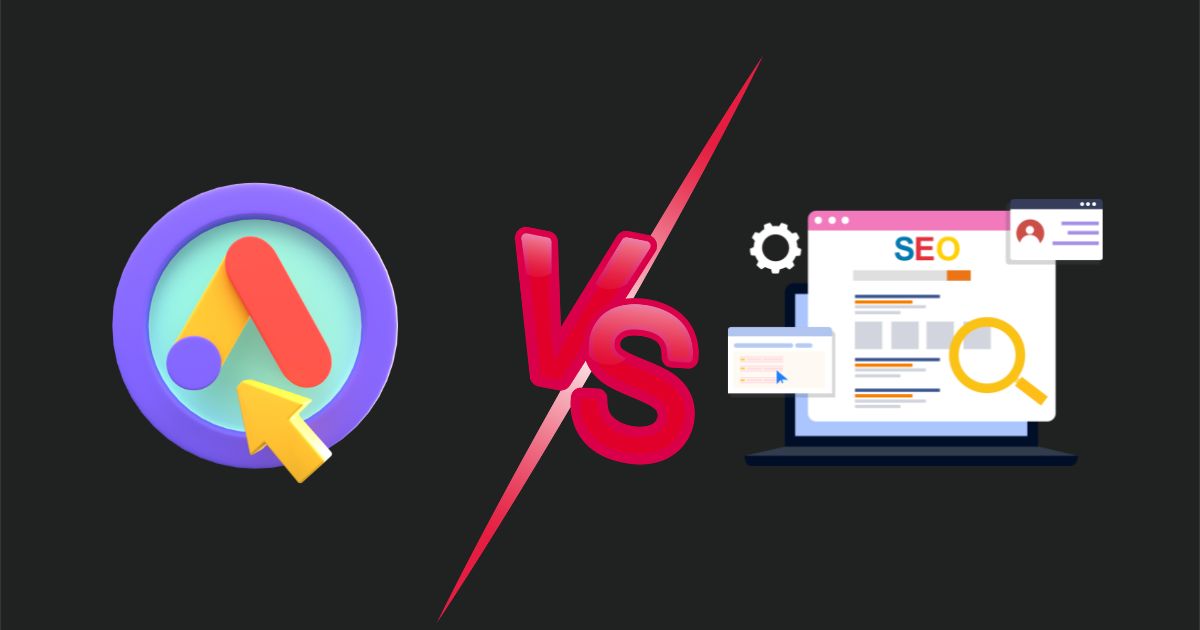
If you want a plain list before making a decision, here it is.
Real trade-offs of each channel.
Google Ads: Pros and Cons
The biggest advantage of Google Ads is speed and control.
You can be visible on the first page of Google within days, you choose exactly which searches trigger your ads, and you can pause or adjust everything in real time.
If something isn’t working, you change it immediately rather than waiting months to see results.
For a business that needs leads now, or wants to test a new offer before committing to a long-term content strategy, that flexibility is genuinely valuable.
The downsides are just as real.
You pay for every click, whether it converts or not, and in competitive industries, those clicks can get expensive fast.
The moment your budget runs out, or you decide to pause, the traffic disappears completely.
There’s no compounding effect, no equity built over time.
You’re always on the treadmill, and the treadmill only runs while you’re paying for it.
SEO: Pros and Cons
The case for SEO comes down to one word: ownership.
A page that ranks well on Google keeps working for you indefinitely, without ongoing per-click spend.
Over time, a well-executed SEO strategy compounds; each new piece of content builds on the authority of everything that came before it, and the cost per lead tends to drop as traffic grows.
There’s also a trust factor: most people instinctively trust organic results more than ads, which can translate directly into higher conversion rates.
The honest downside is patience.
SEO takes time, sometimes a lot of it, and the results aren’t linear.
You can do everything right for three months and feel like nothing is happening, and then suddenly see significant movement in month four.
That uncertainty is hard for a business that needs a predictable lead flow.
SEO also requires consistent effort: publishing content, building authority, staying on top of technical health, and results can be affected by algorithm changes outside your control.
Google Ads vs SEO Cost: What You’re Paying For
Most comparisons between these two channels talk about effectiveness but skip the honest conversation about cost.
Let me fill that in.
For Google Ads, you have two costs to account for.
There’s the management fee, which covers the work of setting up, monitoring, and optimizing your campaigns; you can get a detailed breakdown of what that looks like in this article on PPC management pricing.
And then there’s the actual ad spend, which is what Google charges you per click.
A realistic starting budget for a small service business is $500 to $1,500 per month in ad spend, on top of whatever the management fee is.
For SEO, the cost structure is different.
You’re paying for someone’s time and expertise to audit your site, create content, build authority, and optimize what you have.
If you hire an agency or a consultant, you’re typically looking at a monthly retainer.
The key difference is that you’re not paying per click, and the traffic you earn doesn’t stop when the invoice stops.
You’re building something that, over time, generates leads at no additional marginal cost.
Neither one is cheap if done well.
The question isn’t which one costs less; it’s which one makes more sense for what you’re trying to accomplish right now, with the budget you have.
What About SEO vs PPC: Is It the Same Question?
You’ll often see this comparison framed as “SEO vs PPC” rather than “SEO vs Google Ads,” and the answer is essentially the same.
PPC (Pay-Per-Click) is the broader category that includes Google Ads, Facebook Ads, and other paid channels where you pay each time someone clicks.
If you want to go deeper on how paid advertising is actually priced, our breakdown of PPC vs PPM advertising models explains the key differences between the two most common billing structures.
Google Ads is the most common form of PPC for businesses trying to capture search intent, which is why it’s the one most often directly compared to SEO.
If someone is asking whether SEO or PPC is better, they’re asking the same question we’ve been answering in this article.
The channel names differ, but the trade-off between paying for immediate traffic and building organic visibility over time is identical.
So Which One Should You Choose?
If you’ve read this far and you’re still not sure, here’s a simple framework to help you decide.
- Choose Google Ads if you need leads in the next one to two months, if you’re testing a new offer, if your business is seasonal, or if you’re in a highly competitive market where organic rankings take years to build.
- Choose SEO if you’re playing a long game, if your clients research before buying, if your ad budget is limited or unpredictable, or if you want to build something that keeps working without ongoing spend.
- Choose both if you have the budget to invest in growth and you want to move fast now while building something sustainable for later.
If you’re exploring growth approaches beyond paid and organic search, our post on community-led funnels vs ads covers another model worth considering for sustainable, long-term customer acquisition.
And if you’re still not sure after all of that, the answer is almost always to have an honest conversation about where your business is today, what you can realistically invest, and what timeline you’re working with.
That conversation changes everything, because the right answer for your business at this stage might be completely different from the right answer six months from now.
Our PPC Services Have Helped Our Clients Increase Their Revenue!
“I highly recommend Brimar if your looking to grow your online business. You will be satisfied with the high level of expertise and high quality of services. It has helped my business grow by leaps and bounds.”
CEO